
By: Ami Nadiv
Three summers ago, I had the opportunity of a lifetime to spend five incredible weeks on NCSY’s TJJ Ambassadors. Amidst all the hikes, leadership programs and advocacy training, we managed to journey to a humble shul in the heart of Jerusalem, where an acclaimed Rabbi was sharing some words Torah. After listening to the Rabbi deliver a brief shiur, we, the Ambassadors, requested a bracha from him. To give us our bracha, the Rabbi did something incredibly profound and unexpected. He had each of us lay our hands on the head of the person to our left, and he had us offer our own blessings to our friends. Afterwards, the Rabbi prayed to Hashem and asked Him to accept the brachot we gave our friends and to award us with the very same brachot we just offered.
The sagacious Rabbi was drawing from a very meaningful idea presented in Bava Kamma 92a; the Talmud relates: “Anyone who requests mercy for his fellow, while in need of the same thing, he will himself be answered (as well).” This principal begs a shift in our approach to prayer—it begs us to look beyond ourselves. Ideally, our prayers should be focused on the needs of those around us before our own. This idea can also be seen in parshat Vayera, when Avraham prays on behalf of Abimelech, asking God to heal Abimelech’s plagued household. The very first time we see Avraham utter a prayer to God in the Torah, it is on someone else’s behalf, someone who appears to be a swindling liar—an incredibly immoral person.
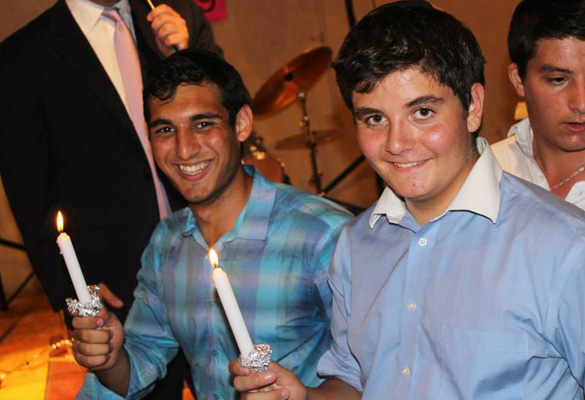
International teen presdent Ami Nadiv (left) and West Coast regional president Sam Hodara proudly hold the candles at Leadership Boot Camp 2013.
When everyone was making new-year resolutions for themselves, mine was to work on the unnatural act of thinking about others before myself. Unfortunately, this Rosh Hashana, I failed. I successfully walked into shul and repeatedly confessed my unworthiness before God, all the while promising Him I’ll repent and be a better person, but still petitioning Him to bless me this upcoming year, asking for: health, happiness, good grades, acceptance into a good college—all the wonderful things that consume the lives of today’s high school students. Sadly, in the many hours I spent communing with the Almighty about myself, I never once thought about the person sitting next to me. And then I realized that most of my shortcomings that I’m working to change require me to start praying for my community and not just for myself.
This time of year, we celebrate the creation of all of humankind, not just ourselves as individuals. My hope is that for Yom Kippur and onward all of you will join me in my process of teshuva, to repent for my attitude on Rosh Hashana, and offer a prayer to Hashem—thus expressing concern for someone outside of our limited bubbles. This is the lesson the Rabbi taught me on Ambassadors: We must always make the well-being of others a priority. This time of year, we must lend our voices to a larger community: to those facing persecution, like our brothers in Syria, poverty, or sickness throughout the world. This year, let’s strive to refocus our attention onto the needs of those who we so sadly overlook.